Catholic Church
The LeopardThe Catholic Church in The Leopard shapes both the intimate routines of the Salina household and the political contest over property and authority in a changing Sicily. Its prayers, confession, and family devotions are woven into daily life, while its charitable role and enduring institutional power become subjects of dispute. The contrast between the Church’s claim to permanence and the fragility of aristocratic privilege reaches from Don Fabrizio Corbera, Prince of Salina’s political reflections in 1860 to the scrutiny of the family chapel in 1910.
Prayer, confession, and family devotion
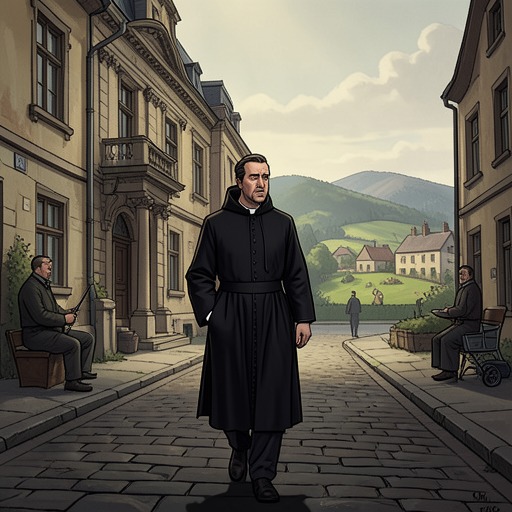
The Church first appears as a practice embedded in the household. After the Salina family’s daily Rosary, the drawing-room’s worldly decoration seems briefly transformed: the parrots and mythological figures on its walls acquire a subdued, almost penitential air. When the prayers end, the room returns to its familiar disorder. Father Pirrone remains absorbed in additional prayer, his cassock accidentally covering Andromeda until he moves and the painted scene is revealed again. The episode places religious observance alongside, rather than outside, the material and aesthetic life of the family.
Confession brings institutional teaching into direct contact with Don Fabrizio’s temper and self-understanding. In the observatory, he treats the previous night’s episode as something Father Pirrone already knows and sees little need to confess. Father Pirrone insists that confession requires not merely disclosure but repentance. The Prince’s amused response gives way to a serious exchange about political change, after which Father Pirrone reminds him that he has sins of both the flesh and the spirit to confess. Their friendship and habitual intimacy soften the confrontation but do not erase the priest’s insistence on the Church’s sacramental terms.
The family’s religious observances also connect it to inherited privilege. By longstanding custom, the Salinas visit the Convent of the Holy Ghost after arriving in Donnafugata to pray at the tomb of Blessed Corbera, the Prince’s forebear and the convent’s foundress. The convent’s strict enclosure ordinarily excludes men, yet Don Fabrizio may enter as her direct descendant; the King of Naples shares that exceptional right. He takes conspicuous, almost childlike pride in the privilege, and enjoys the convent’s plain parlour, the double grilles, the message wheel, and the nuns’ accounts of the foundress’s miracles. Family descent thus grants access to a religious space whose ordinary rule is exclusion.
The Church and political change
During the upheaval of 1860, the Church’s property and social role become central to an argument between Father Pirrone and Don Fabrizio. Father Pirrone fears that nobles will accommodate Liberals and Freemasons at the Church’s expense, and that ecclesiastical holdings, which he regards as resources sustaining the poor, will be confiscated and divided among political leaders. He further anticipates that the destitute will eventually receive portions of the great estates as well. His alarm is not only about institutional loss: he asks who will feed and guide people now supported by the Church.
Don Fabrizio answers from the perspective of a class conscious of its own declining security. He distinguishes the Church, promised immortality, from the aristocracy, which has no such guarantee. The Church, he argues, may preserve itself by sacrificing the social class to which he belongs; its desperation is inseparable from its longevity. This is the Prince’s political interpretation, not a neutral account of Church policy, and Father Pirrone does not simply endorse it. Their exchange makes the conflict concrete: property, charitable provision, and the survival of institutions are bound together, but the two men judge the coming redistribution from different positions.
The prospect of ecclesiastical loss also circulates beyond their private conversation. Don Pietro Russo assures the Prince that the only people who will lose under the anticipated changes will be priests, presenting this as part of a promised improvement in security, trade, and everyday life. At the Donnafugata plebiscite, Father Pirrone does not vote because he has avoided being registered as a town resident. These details place the clergy within the political transition without making them a single, unified political voice: the priest’s refusal to participate formally contrasts with the confident public predictions made by local figures.
Private worship under ecclesiastical scrutiny
The Church’s authority over devotion reappears in 1910, when the Cardinal Archbishop begins inspecting private chapels in the Palermo archdiocese under Papal instructions. The inquiries concern the worthiness of those permitted to hold services at home, the conformity of liturgy and decoration, and the authenticity of venerated relics. The Salina chapel attracts particular attention because rumours have circulated about its collection of relics and its cherished painting. The family’s reluctance to admit outsiders to its sacred rites has protected its privacy, but cannot settle the question of authenticity for the Church.
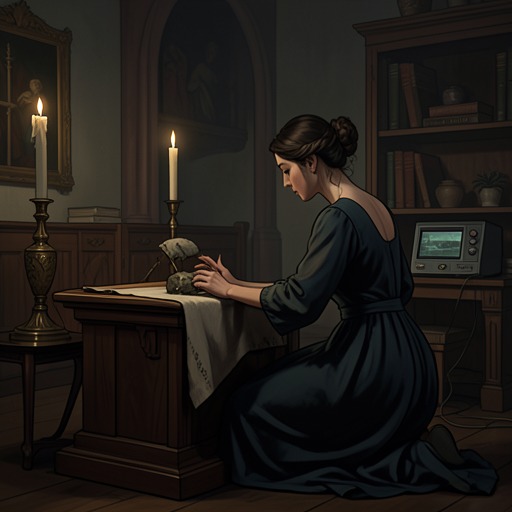
The chapel itself was established only after Don Fabrizio’s death, when inheritance complications left Villa Salina to his three daughters alone. They converted an out-of-the-way drawing-room, altered its decoration, and installed an altar. During the inspection, the sisters’ revered painting is identified as the Madonna of the Letter: a graceful young woman holding a crumpled letter, without the customary symbols that would clearly identify the Virgin Mary. The visiting prelate admires its expressiveness, while the sisters make the sign of the Cross and recite an Ave Maria. The scene sets private devotion beside the inspecting authority’s attention to the image as an object requiring examination.
The later examination of the relics is methodical and material. A priest trained at the Vatican School of Palaeography takes the case keys and works for three hours with a hammer, saw, screwdriver, magnifying glass, and pencils. He emerges with a basket of discarded papers, cards, boxes, and fragments of bone and cartilage, and reports that only five relics are fully authentic and worthy of devotion. His findings sharply reduce the family collection while preserving a smaller group for veneration. The Church’s authority here operates not through argument alone but through inspection, classification, and the physical separation of objects judged genuine from those rejected.
Institutional permanence and family decline
Across these episodes, the Catholic Church is both a lived religious presence and an institution whose resources and judgments have public consequences. The Salinas’ prayers and convent privilege bind devotion to family habit and inherited status; Father Pirrone’s concern for the poor makes church property part of a wider social economy; and the 1910 inspection places private religious practice under formal ecclesiastical review. Against the Prince’s image of aristocratic life as temporary, the Church’s claim to endure is tested through political dispossession and the scrutiny of its sacred objects. The family chapel’s reduced collection gives that contrast a physical form: inherited reverence persists, but its material contents are no longer beyond institutional question.